
Checklist for Happy Kittens 🐾
Compartilhar
AUTHORED BY:
M.V. Esp. Yasmin Cunha – CRMV-RS 1617-9
Specialization in Feline Internal Medicine
Specialization in Veterinary Nephrology
Instagram: @veterinariayasmin
In our last newsletter, we discussed "Cat-Friendly Homes: Strategies for creating a stimulating and engaging environment for cats, promoting their physical and mental well-being." We mentioned a Checklist for happy kitties, and now we will explore each item in more detail. Shall we?
🐾 Checklist for happy kitties
Food and sensory enrichment:
Starting with food-related activities, the goal is to transform feeding into a more stimulating and natural experience for the cat, promoting what is called active feeding. You can use interactive feeders and toys designed for this purpose, which require the cat to think, explore, and "work" a little to get their food. Another accessible and effective option is to reuse materials we have at home, such as:
- Toilet paper rolls
- PET bottles with holes
- Boxes and egg cartons with hidden treats
These alternatives are simple, inexpensive, and very effective in making mealtime more interesting and challenging.
Note: I, veterinarian Yasmin, do not recommend leaving all kibble available only in
active feeding toys. It is essential that the cat has options. Active feeding should be a complementary and enriching tool, but not the only way to access food.
Sensory enrichment aims to stimulate the cat's senses in a safe and positive way, contributing to the animal's emotional balance and well-being. Below are the main aspects to consider:
- Hearing:
Cats have extremely sensitive and refined hearing. Soft sounds help create a calmer environment, especially during times of stress or routine changes. A good tip is to use playlists like Relax My Cat, which offer music with frequencies specially designed for felines.
- Smell:
Smell is one of the most important senses for cats. It is crucial to keep the environment as neutral as possible in terms of odors. A safe and scientifically backed alternative is the use of synthetic feline pheromones, such as feline facial pheromone (F3), which transmit messages of security and comfort. They can be used in diffusers or sprays, especially in situations of change, adaptation, or stress.
- Touch, sight, and taste:
These should also be stimulated with the use of different textures in the environment, moving toys, varied treats, and daily opportunities for exploration. These experiences contribute to the cat's mental health and daily satisfaction.
Each cat is unique, and it is essential to observe how they react to each stimulus to adjust the
environment in a personalized and respectful way.
Water bowls and fountains:
Avoid plastic materials. Offer options of different sizes, colors, and shapes — cats are naturally curious!
💡 General rule (valid for all key resources*): number of cats + 1.
Example: 3 cats = at least 4 water bowls.
Regarding fountains, there are several models on the market. Observe which one your cat prefers.
⚠ Important: do not leave only fountains available — in case of a power outage, access to water may be compromised.
Food bowls:
Prefer materials like porcelain or ceramic and avoid plastic.
Follow the same rule: number of cats + 1.
⚠ Food bowls (and all resources) should not be grouped — spread them around the house to offer freedom of choice.
Vertical enrichment:
Niches, shelves, bridges... everything is welcome! But remember to plan carefully: your cat needs a safe path to go up and down.
Scratching posts:
Invest in large, stable models with varied textures. They are essential for the cat's natural behavior and prevent them from using furniture as an alternative.
Appropriate litter box and litter (PBCAT ❤):
The ideal box should be 1.5 times the length of the cat (from nose to tail base) and wide enough for them to turn around comfortably. It needs to be large, stable, and open.
Regarding litter, it must meet 5 prerequisites:
1. Light color – to monitor changes in urine
2. Unscented – respects the feline sense of smell
3. Forms firm clumps – facilitates cleaning
4. Comfortable granularity for paws
5. Low dust production
👉 Do you know which litter meets all these requirements? Our favorite: PBCAT!
Resting areas:
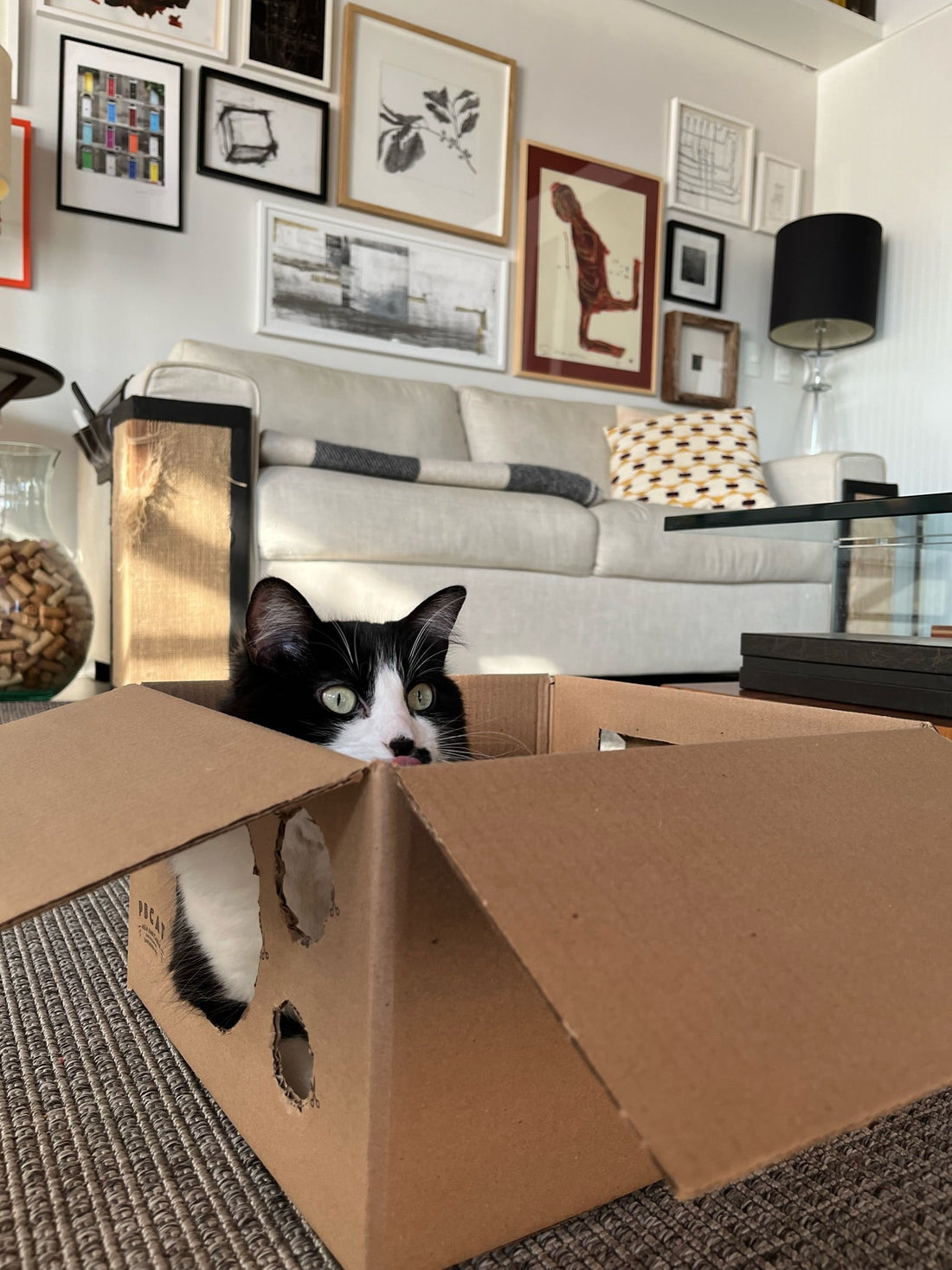
Beds, dens, blankets, cardboard boxes... the important thing is to ensure comfort and variety.
Hiding spots:
Cats love to hide! Offer dens, niches, boxes... they need to feel safe.
Carrier:
Ideally with a top opening, spacious enough for the cat to turn around, and made of safe and resistant material.
Toys:
Prefer toys that simulate hunting: large, soft, and safe.
Have you heard of structured play? This type of play is designed to
simulate the natural hunting behavior of cats, allowing them to express all stages of the predatory sequence.
Structured play follows these steps:
Locate – the cat observes and identifies the target
Stalk – it approaches slowly and prepares for the attack
Capture – with a quick jump or pounce, it grabs the toy
Kill – upon reaching the toy, it may bite quickly or press with its paws,
as if killing the prey
Prepare – after capturing, the cat may manipulate the toy with its paws and mouth, simulating the preparation of prey, as they would when tearing off meat
Eat – to complete the cycle, it is important to offer a food reward, such as a
treat or a meal, immediately after playtime
This type of interaction is fundamental for the physical and mental well-being of cats, as it respects and satisfies their natural instincts. In addition, it strengthens the bond between owner and cat and helps prevent behavioral problems related to boredom and stress.
Quality food:
The foundation of health lies in nutrition. Choose appropriate, well-formulated, and high-quality food.
Physical exercise:
Essential for maintaining a healthy body and mind. Playtime, obstacle courses, and scratching posts help a lot.
Veterinary care:
Regular check-ups, up-to-date vaccinations, and preventive exams ensure long-term well-being.
Remember: each cat is unique in its way of being, but all are wonderful — and deserve an environment where they can simply be cats (the sovereign kings of the universe).
Note: 💡 The general rule — number of cats + 1 — applies to all key resources:
food bowls, water bowls, resting areas, scratching posts, and litter boxes. It is always
essential not to group these resources. Distributing them around the house prevents disputes, offers freedom of choice, and contributes to harmony in the environment.
References:
CARNEY, Hazel C. et al. AAFP and ISFM feline-friendly nursing care guidelines. Journal of Feline Medicine and Surgery, v. 14, n. 5, p. 337–349, 2012. DOI: 10.1177/1098612X12445002.
CROWELL-DAVIS, S. L.; CURTIS, T. M.; KNOWLES, R. J. Social organization in the cat: a modern understanding. Journal of Feline Medicine and Surgery, v. 6, p. 19–28, 2004.
LITTLE, Susan E. et al. O gato: medicina interna. Rio de Janeiro: Roca, 2016.
RODAN, Ilona et al. AAFP and ISFM cat friendly veterinary interaction guidelines: approach and handling techniques. Journal of Feline Medicine and Surgery, v. 24, p. 1093–1132, 2022.
RODAN, I.; RAMOS, D.; CARNEY, H. et al. 2024 AAFP intercat tension guidelines: recognition, prevention and management. Journal of Feline Medicine and Surgery, v. 26, n. 7, 2024. DOI: 10.1177/1098612X241263465.